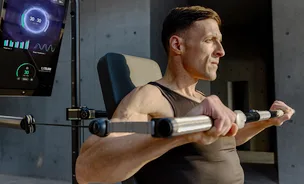
- The size of the step between angles matters more than the number of angles. 5° steps give real control over the chest angle.
- The folded height is what decides whether it gets stored or not. 15 cm fits under a bed. 40 cm stays in the middle of the living room.
- The weight of the bench is a compromise. Too light — it shifts mid-exercise. Too heavy — nobody moves it.
- A flat bench is cheap, but it blocks half the exercises. Without an incline there is no upper-chest press and no seated back support.
Why you need a bench at all
A smart strength machine opens up dozens of standing exercises. But the moment you want a chest press, seated shoulders, supported curls or any exercise that needs a supported back — you need something to sit or lie on.
The bench is also what turns one machine into a system: it adds angles you cannot create standing up.
1. Angle — the figure that decides
Cheap benches offer three or four fixed positions. That sounds like enough until you try it.
The difference between a 30° and a 45° incline in a chest press is the difference between working the upper chest and working the front deltoid. If the bench jumps from 30 straight to 45, you have no control over what you are actually training.
The B1 bench adjusts from 30° to 90° in 5° steps — that is 13 positions in that range, not three.
2. Folded height — the figure that decides whether it gets used
This is the item people dismiss most and that matters most in practice.
A bench that folds to 15 cm fits under a bed, behind a door or beside the wardrobe. A bench that folds to 40 cm stays standing in the living room, and after a month it becomes a place to put things on.
| B1 | B3S | Typical flat bench | |
|---|---|---|---|
| Angles | 30°–90°, 5° steps | Folding, with leg supports | Fixed, flat only |
| Folded height | 15 cm | Folding, leans against a wall | Doesn't fold |
| Weight | 18.85 kg | 13.2 kg | 8–15 kg |
| Material | Aluminum and stainless steel | Steel | Steel |
| Static load | — | 400 kg (tested above 475) | Varies |
3. Stability against weight — the real compromise
A bench that is too light shifts when you push against it. A bench that is too heavy doesn't shift — and doesn't get moved into storage either.
18.85 kg is the range in which a bench stays stable under load and can still be lifted with one hand. Below 12 kg you start to feel movement in heavy pressing; above 25 kg most people simply stop folding it.
The material matters here: a combination of aluminium and stainless steel gives a good stiffness-to-weight ratio, and doesn't rust on an enclosed balcony or in a safe room.
4. The padding and what is underneath it
Two things worth checking on any bench, from any brand:
- The width of the pad. Too narrow — uncomfortable when pressing. Too wide — it restricts the shoulder blades through the movement.
- What happens at the joint between the sections. In the incline position, is there a gap between the backrest and the seat? A large gap is a pressure point in the lower back.
Why we dropped the flat-bench option
Until recently you could order the kit with a flat bench. We stopped, deliberately.
The reason is simple: a flat bench saves a few hundred shekels and blocks half the exercises the machine can do. People bought it to save money, then discovered they were missing the incline. Better to say so up front.
Today there are two options — B3S or B1 — and you can also order a kit with no bench at all, if you already have one at home.
Assembly
B1 arrives assembled. B3S and the accessory stand need about 20 minutes of simple assembly, with guides and videos. Delivery is 650 ₪ and includes carry-in.