- A multi-trainer is cheaper on the day you buy and simpler to maintain. There is no electronics to fail.
- A smart machine saves space dramatically — 0.30 m² folded against a station that never moves.
- The weight increments are the everyday difference. 5 kg against 0.5 kg.
- There is no absolute winner. One question decides it: how much space you have, and how much you lift.
Two approaches to the same problem
A multi-trainer is a single station with a plate stack and a few pull points — a high pulley, a low pulley, sometimes a press station too. You move a pin between plates and change the handle.
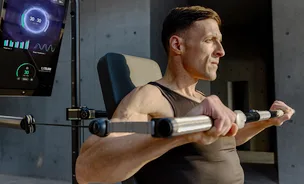
A smart strength machine produces the resistance in motors rather than plates, and changes it from the screen.
Both try to solve the same problem — a whole gym in one corner — and they come at it from opposite directions.
The table of differences
| Multi-trainer | Smart strength machine | |
|---|---|---|
| Source of resistance | Plate stack | Servo motors |
| Weight increments | usually 5 kg | 0.5 kg |
| Folded footprint | Doesn't fold | 0.30 m² |
| Noise | Plates clashing | Motors, like a fan |
| Power | Not required | ordinary 230V |
| Workout tracking | Manual | Automatic, camera included |
| Maintenance | Cables and pulleys | Cables, pulleys and electronics |
| Exercises | Limited to the pull points | 23+ machines, two independent arms |
Where a multi-trainer is better
Let's say it plainly, because it's true:
- Entry price. A good multi-trainer costs less than a smart machine.
- Simplicity. No software, no updates, no screen that can fail. A mechanical station can work for 20 years.
- Heavy weights. Plate stacks easily go above 100 kg on a single pull point.
- No dependence on electricity.
If you have a storeroom or a dedicated room, you lift heavy, and you don't need tracking — a multi-trainer is a perfectly sensible choice.
Where a smart machine is better
- Space. This is the big difference. A multi-trainer occupies its corner 24 hours a day. A folding machine takes 0.30 m² when you aren't training, and 160 × 180 cm when you are.
- Precision in progression. A 5 kg jump in a shoulder press is a jump of tens of percent. 0.5 kg allows real progress week after week.
- Load that changes through the movement. A plate gives a constant force. A motor can increase it where you are strong and reduce it where you are weak.
- Safety. A motor drops to zero instantly. A plate does not.
- Two independent arms. 50 kg on each, at a different load if you want — something a single plate stack cannot do.
- Tracking. People training alone at home usually don't log anything. A camera following 42 points on the body does it for them.
The question that decides it
In practice, the decision comes down to two questions:
- How much space do you have, and does it need to be cleared? If the machine has to disappear between workouts — a multi-trainer isn't really an option.
- How much do you lift today? If your squat is over 140 kg, a ceiling of 100 kg will limit you, and we would rather tell you that up front.
What about maintenance
That is a fair reservation. A machine with motors, a screen and a camera is a more complex product than a mechanical one.
What to check with any brand: who provides service in the country, whether the unit is serviced at the customer's home, and what is covered. With us — a two-year manufacturer's warranty on the unit and 12 months on the accessories, handled in Israel by us, with the option to extend to 4 or 5 years. The full warranty certificate is here.