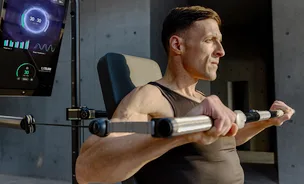
- The S1 Pro is the only one of the three with a built-in camera. Speediance and IMBODY don't have one — and that's not a question of software version, it's a question of hardware.
- 42 tracking points on the body, in real time. That's where mid-rep form correction comes from — something none of the competitors offer.
- A six-dimension body assessment before a program is built, not a questionnaire at the start.
- No subscription. With Speediance, the AI add-on requires a monthly payment. With us, everything is included.
- And what it isn't: it isn't a personal trainer, it doesn't diagnose injuries, and it won't replace good judgment. We'll explain exactly where the line is.
Two kinds of “AI” — and only one of them sees you
When you read the specs of smart strength machines, the word AI appears in all of them. But it describes two completely different things:
- AI that looks at numbers. How much you lifted, how many reps, how long. From that, it works out what to give you tomorrow. It's useful, and it's what most machines have.
- AI that looks at you. A camera that sees the movement itself — your back, your knee, your tempo — and responds to it as it happens.
The difference isn't in how deep the algorithm goes. It's in the hardware: without a camera, there's nothing to analyze except the numbers. Speediance and IMBODY have no built-in camera, and so they have no real-time form correction either — not in this version, and not in a future software update.
A machine that knows how much you lifted knows what happened. A machine that sees how you lifted knows why.
What the 42 points do
The system identifies 42 key points on the body — joints, shoulders, pelvis, knees — and tracks them throughout every rep. From this, it derives three things a number on a screen can't give you:
- Symmetry. If one side is working harder than the other, it shows in the movement long before you feel it.
- Range of motion. On a blind machine, a half rep counts the same as a full one. Not here.
- Tempo and breakdown. The moment your form starts to fall apart at the end of a set is exactly the moment injuries happen.
The six-dimension assessment
Before the system builds a program, it measures. The six-dimension body assessment is the starting point — not a questionnaire asking “what's your goal”, but a measurement of where you really are today. The program built afterwards updates based on your actual performance, not a schedule fixed in advance.
Each household member has a separate profile — up to nine — with their own measurements, history and program. A partner who trains twice a week and a teenager who trains five times don't share the same program just because they share the same machine.
Real-time correction — why it matters especially at home
At the gym, there's someone to point things out. In your living room, there isn't. That's why most people who train alone settle into mediocre form and stay there for years — not for lack of will, but because nobody told them.
The system gives feedback during the rep, not in a summary at the end of the workout. And when it detects that a rep is stalling, assist mode reduces the weight instead of leaving you to struggle with it. In an emergency, resistance drops all the way to 0 — there's no physical weight that keeps falling, because there's no physical weight.
Who knows what
| Capability | AEKE S1 Pro | Speediance Gym Monster 2 | IMBODY Power S Pro |
|---|---|---|---|
| Built-in camera | Yes · 42-point tracking | ✕ | ✕ |
| Real-time form correction | ✓ | ✕ | ✕ |
| Body assessment before the program | Six dimensions | ✕ | ✕ |
| Assist · the motor reduces the weight | ✓ | ✓ | ✓ |
| Full drop to 0 for safety | ✓ | ✓ | ✕ |
| Subscription for AI features | No subscription | Required for the AI add-on | No subscription |
| Household profiles | 9 | Available · number not published | Not published |
What this AI doesn't do
We claim to be the best in this category, and that's exactly why we should be precise about the limits too. Otherwise, the rest means nothing:
- It isn't a personal trainer. The system corrects movement — it doesn't know about your old injury and won't build a competition prep cycle.
- It isn't a medical diagnosis. Pain is a sign to stop and consult a qualified professional, not data to feed into a machine.
- For an advanced lifter, it's a safety net, not a program. If you've been lifting for years and know exactly what you're doing — the main value here is the assist and safety when training alone, not the coaching.
- A camera needs to see. A very dark room or a position that blocks its field of view will reduce accuracy. It's something to consider when placing the machine, and there's a guide for it.
An independent review by T3 found that, unlike other fitness mirrors, the machine has everything needed for a complete strength workout, thanks to the two cables that extend from the robotic base.T3 · Read the full review
Three international design awards — Red Dot, IDA and CMF.International design awards for AEKE machines
The most-funded project in the home gym category on Kickstarter in 2026 — $5,866,348 from 1,885 backers in 39 days.Kickstarter · reported by PR Newswire and The Globe and Mail, July 2026