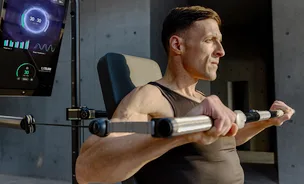
- Maximum resistance matters less than it seems. Most home users never reach 100 kg on a single exercise. What does matter: the size of the jump between weights.
- Subscription fees are the item that is easiest to miss. 49 ₪ a month is almost 3,000 ₪ over five years — more than the gap between most models.
- Check who provides service in Israel. A 110 kg machine doesn't go back to China by post.
- The space the machine takes up open matters more than the space it takes up folded. You train in the open position.
Why one machine instead of equipment at all
The logic behind a smart strength machine is simple: instead of a weight rack, a bench, a bar and a cable machine — a single unit that produces resistance through electric motors, and changes it in a second.
That removes the part that kills home workouts: swapping plates between sets, and the pile of equipment with nowhere to live. With ours, for example, the machine replaces 23+ machines — not as a slogan, but because that is the number of exercises the system can resist through two independent arms.
But it also means you are buying one product that has to work. If it isn't precise, safe or comfortable — you have no plan B.
1. Resistance: not how much, but how precisely
Every manufacturer publishes a big number. The figure that is genuinely interesting is the increment size.
A machine that jumps in 2.5 kg steps forces you to choose between too light and too heavy. A machine that jumps in 0.5 kg lets you actually progress — especially in shoulder and arm exercises, where half a kilo is two weeks of difference.
The AEKE S1 Pro has 100 kg in total, 50 kg per arm, in half-kilo steps. If you squat 140 kg — this is not the machine for you, and we say so plainly on the comparison page too.
2. Space: measure the open position
Every manufacturer publishes the folded dimension. It is nice, but you don't train folded.
The figure you should measure on the floor at home:
- Folded: 71.5 × 42.5 × 185 cm — 0.30 m².
- Open for training: 71.5 × 135.5 × 185 cm.
- Recommended training area: 160 × 180 cm, with a ceiling height of 220 cm.
Put masking tape on the floor at those dimensions before you order anything — whatever the brand. It is the cheapest check you will ever run.
3. Subscription fees: the real arithmetic
Some machines on the market require a monthly subscription to unlock the AI features, the programmes or the profiles. The price looks small at the till and large in hindsight.
Every 50 ₪ a month is 3,000 ₪ over five years. That is no longer a small item — that is the gap between models.
We have no subscription fees, on any feature, ever. That is a business decision and not a launch promotion.
4. Safety: what happens when a rep fails
This is the biggest difference between iron and motor-driven resistance, and few people ask about it.
With free weights, a failed last rep ends with iron on your chest. With motors, the system can drop the resistance to 0 instantly, and there is an assist mode that takes weight off mid-movement.
On the electrical side you should confirm under-voltage protection, earthing and residual-current protection. We have them; with others — ask, and ask for the answer in writing.
5. The second person in the house
This is the point that affects the economics most and that people discuss least.
A machine that serves one person competes with one membership. A machine that serves two or three competes with two or three memberships — and the arithmetic changes completely. So it is worth checking how many user profiles the machine supports, and whether switching between them takes a second or a minute.
Check the physical fit range too. Ours is recommended for ages 18–70, heights 150–200 cm and body weights 40–150 kg. If someone in the house is outside that range — that is a real consideration.
6. Warranty and service — in Israel
A 110 kg machine is not something you return by post. Before you buy, clear up three questions:
- Who actually provides the service — the importer, or a call centre abroad?
- Is the heavy unit serviced at the customer's home?
- What exactly is covered, and for how long?
Ours: a two-year manufacturer's warranty on the unit and 12 months on the accessories, handled in Israel by us, with the option to extend to 4 or 5 years. It is all written in the warranty certificate.
7. AI — two entirely different words
The word AI appears on every box on the market, and it describes two different things:
- AI that looks at numbers. How much you lifted, how many reps. From there it builds the next workout. That is useful, and it is what most machines have.
- AI that sees you. A camera that follows the body and corrects technique mid-rep.
The difference is hardware, not software: without a camera there is nothing to analyse beyond the numbers, and no software update will add a lens. The S1 Pro tracks 42 points on the body in real time. We went into this in a separate article.
The list worth taking into a conversation with any seller
- What is the increment between weights?
- What are the dimensions in the open position?
- Are there subscription fees — today, and in two years?
- Who handles a fault, and where?
- How long does assembly take, and who carries the machine into the house?
- What happens if you fail a rep?