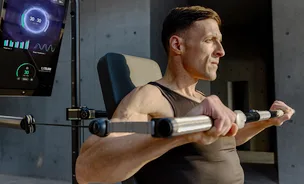
- The measurement that matters is the training area, not the folded footprint. 160 × 180 cm, ceiling height 220 cm.
- Folded, the machine takes up 0.30 m² — 71.5 × 42.5 cm, less than an armchair.
- No drilling, no wall anchor and no ceiling anchor. You can move it to another room.
- The floor matters more than the walls. 110 kg concentrated on a small base.
The number everyone publishes, and the number you need
Every manufacturer publishes the folded dimension, because it is impressive. It is also irrelevant to the moment you are training.
For the AEKE S1 Pro:
| State | Width | Depth | Height |
|---|---|---|---|
| Folded | 71.5 cm | 42.5 cm | 185 cm |
| Open for training | 71.5 cm | 135.5 cm | 185 cm |
And above both, the number that really decides: a recommended training area of 160 × 180 cm, with a ceiling height of 220 cm. That area includes the space where you stand, step back during an exercise, and raise your arms overhead.
A five-minute check before you buy anything
Do this with masking tape, before you order any machine on the market — ours or anyone else's:
- Mark a rectangle of 160 × 180 cm on the floor.
- Stand in the middle and raise both arms overhead. If you touched the ceiling or a light — you need a lighting solution, not a different machine.
- Sit on the floor and lie back. Is there room?
- Check where the nearest power socket is.
If the rectangle doesn't fit — no specification will help.
Where in a flat it actually works
From our experience with installations in Israel, four places come up again and again:
- A corner of the living room. The most common. Folded, the machine looks like a narrow piece of furniture against the wall.
- A home office or a safe room. Works very well; just watch the ceiling height — in a safe room it is sometimes lower.
- An enclosed balcony. Possible, but only if it is genuinely enclosed. Damp and dust are the enemies of motors and screens.
- A bedroom. Works, provided there are 180 cm free beside the bed and not only in front of it.
What works less well: a storeroom with no power, an open balcony, and anywhere you'd have to drag the machine up stairs every time.
The floor, not the wall
This is the point that surprises people most. The machine does not attach to the wall or the ceiling — no drilling, no anchoring, and if you decide to move it to another room, you can.
What does need attention is the floor: the machine weighs about 110 kg net and stands on a relatively small base. On ordinary tiling there is no issue at all. On parquet or laminate it is worth putting a rubber mat underneath — both for the floor and for the quiet.
Noise — what the neighbours will hear
The resistance is produced by motors rather than iron plates. That removes the main source of noise in home strength training: there is no sound of weights clashing and no plate dropping on the floor.
What you do hear: the motors themselves, at about the volume of a fan, and your own breathing. If you are coming from running on a treadmill in a flat — this is considerably quieter.
What about the bench and the accessories
If you took a kit, two items add storage volume:
- The B3S bench — folding, 13.2 kg, leans against a wall at a small depth.
- The B1 bench — aluminium and stainless steel, adjustable from 30° to 90° in 5° steps, folds to a height of 15 cm and weighs 18.85 kg. Folded, it fits under a bed or behind a door.
You can also order a kit with no bench at all, if space is genuinely tight.