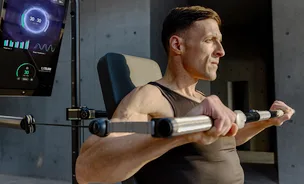
- Iron gives a fixed load. A motor gives a load you can change mid-rep. That is the essential difference, and everything else follows from it.
- Safety: a motor can drop to 0 instantly. A 60 kg plate cannot.
- Precision: 0.5 kg increments instead of 1.25 or 2.5 kg.
- Iron still wins at very heavy loads and on entry price. We don't pretend otherwise.
How it actually works
In a classic cable machine, the cable lifts a stack of plates. The force you feel is gravity acting on a mass — fixed, predictable, and impossible to change mid-movement.
The AEKE S1 Pro has no plates. The cable is connected to servo motors, and the motor pulls in the opposite direction. The resistance is the result of an electrical current rather than a mass — and so it can be changed within thousandths of a second.
In practice: 100 kg in total, 50 kg per arm, in half-kilo steps.
The real difference: load through the movement
This is the point that justifies the whole technology, and it isn't a number on a spec sheet.
Every exercise has a weak point. In a chest press it is the bottom; in a biceps curl it is the straight angle. With iron, the weight you choose is set by the weakest point — which means through the rest of the range you are training too light.
With iron you train to the weakest link. With a motor you can train across the whole range.
A motor can increase resistance precisely where you are strong and reduce it where you are weak. The same rep, more muscular work, without adding risk.
Safety — the point people discuss least
A scenario familiar to anyone who has trained alone at home: the last rep, the strength runs out, and the bar is on your chest.
With motor-driven resistance that scenario doesn't exist in the same way. The system can drop the resistance to zero instantly, and there is an assist mode that takes weight off mid-movement as the speed falls. There is no plate to hold and no bar to rack.
On the electrical side there is under-voltage protection, earthing and residual-current protection. That is not a marketing line — it is what makes it acceptable to put a machine like this in a living room with children.
Noise and space
Two advantages that follow directly from the absence of iron:
- Noise. No plates clashing and no weight dropping. What you hear is the motors, at about the volume of a fan.
- Space. 100 kg of resistance in a machine that folds to 0.30 m². An equivalent plate stack takes a whole wall.
Where iron still wins
Let's be fair, because we also sell to people who won't buy:
- Very heavy loads. If your squat is 140 kg, a ceiling of 100 kg will limit you.
- Entry price. A set of weights and a bench cost less than a smart machine. The gap closes over time against a gym membership, but on the day you buy, iron is cheaper.
- Feel. Some experienced lifters simply prefer the feel of iron. That is a legitimate preference and there is no arguing with it.
- Zero dependence on electricity. A weight works during a power cut too.
What about durability
A fair question about a motor-driven system: how long does it last.
The figures we publish: the frame is structural steel and the load-bearing components are forged steel. Structural strength — 150 kg per side on the column, 150 kg per side on the arm, and 720 kg on the foot platform. The cables have a rated strength of 300 kg and passed 30,000 cycles under 25 kg.
The unit carries a two-year manufacturer's warranty, handled in Israel, with the option to extend to 4 or 5 years.